
Class 4 vs Class 5 Softswitch: What’s the Difference?
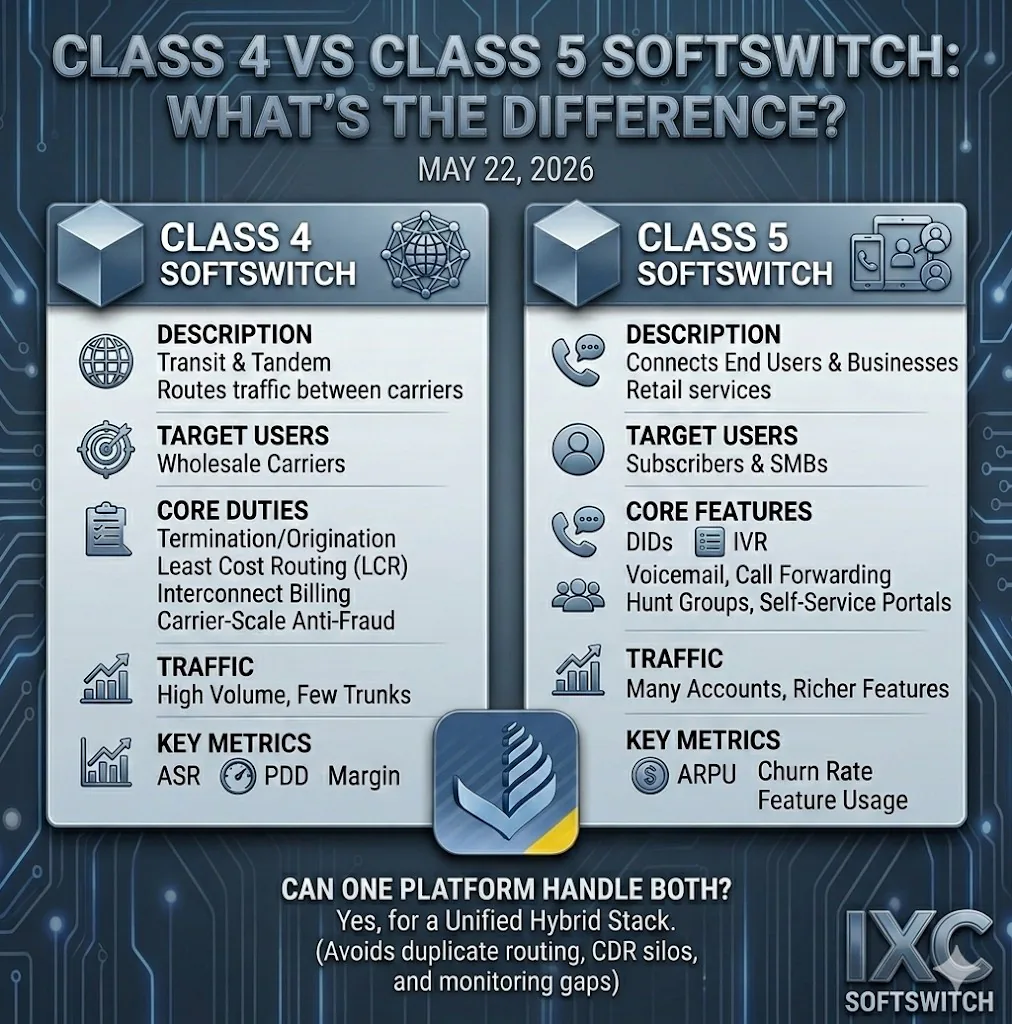
Wholesale and retail VoIP operators often hear Class 4 and Class 5 when evaluating a softswitch. The labels come from the traditional telephone network but describe two different roles: carrier transit versus subscriber services.
Class 4 softswitch
A Class 4 (transit/tandem) switch routes high-volume traffic between carriers. It does not serve end subscribers directly.
Typical duties: wholesale termination and origination, LCR, protocol conversion (SIP/H.323), high channel capacity, interconnect billing, and carrier-scale anti-fraud.
Class 5 softswitch
A Class 5 switch connects end users and business customers with features they expect: DIDs, IVR, voicemail, forwarding, hunt groups, and self-service portals.
How they differ
- Users — Class 4: carriers; Class 5: subscribers and SMBs
- Traffic — Class 4: few trunks, high volume; Class 5: many accounts, richer features
- Billing — Class 4: per-minute interconnect; Class 5: retail packages and balances
- Metrics — Class 4: ASR, PDD, margin; Class 5: ARPU, churn, feature use
One platform or two?
- Wholesale-only — Class 4 is essential; Class 5 optional unless you resell with sub-accounts.
- Retail-only — Class 5 is core; some destinations still need wholesale peering behavior.
- Hybrid — Both on one stack avoids duplicate routing tables, CDR silos, and monitoring gaps.
Summary
Class 4 is transit and wholesale economics; Class 5 is subscriber service delivery. Growing operators usually need both capabilities aligned on shared routing, billing, and quality data.
Frequently asked questions
Can one softswitch handle Class 4 and Class 5?
Yes. Many platforms combine wholesale routing and retail subscriber features on a single routing and billing core.
Which class matters more for LCR?
LCR is primarily a Class 4 wholesale function, though retail routes can use similar logic for cost control.
Do I need Class 5 for wholesale-only?
Not always. Pure wholesalers focus on Class 4; Class 5 becomes relevant when you sell services directly to end users.