
VoIP Fraud Prevention on a Softswitch: SIP Security & FAS
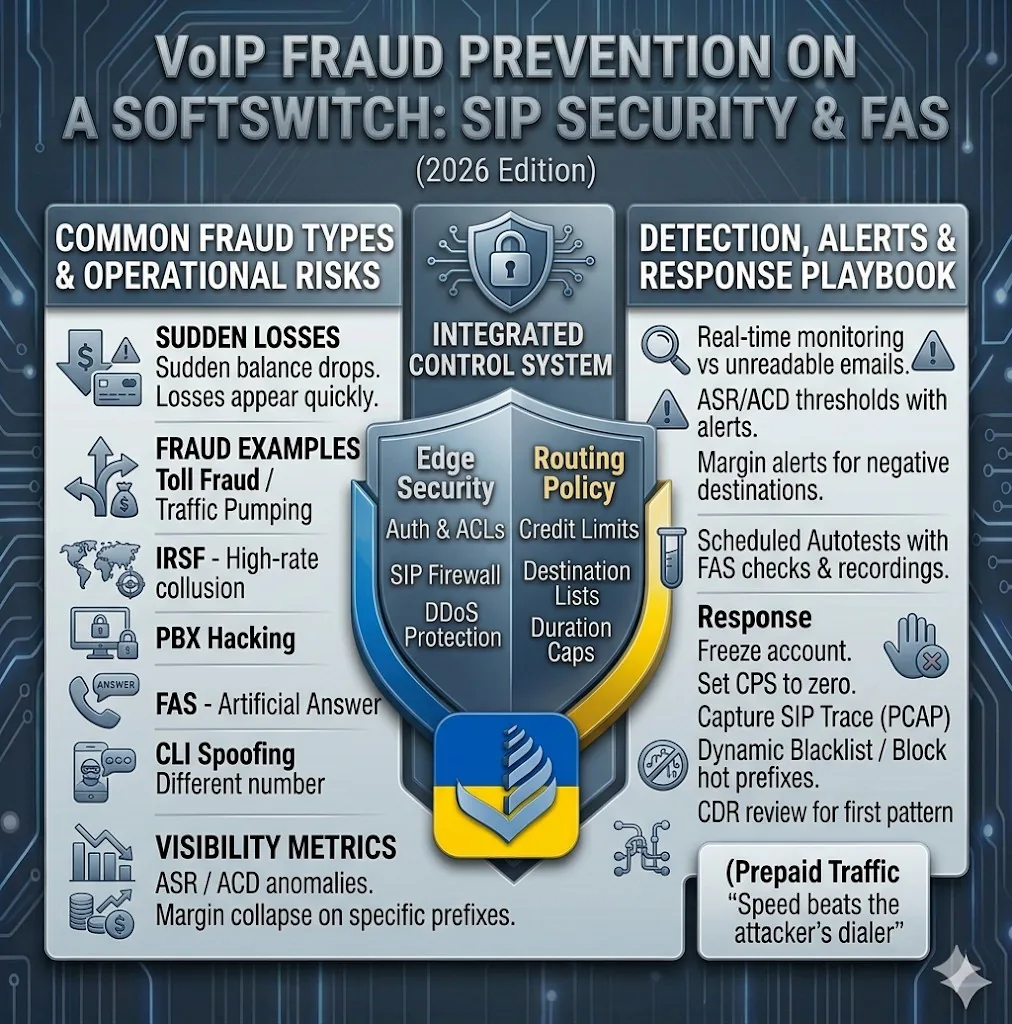
VoIP fraud can drain a prepaid balance in minutes. A carrier softswitch is the first control point when routing, lists, and monitoring live together.
Common fraud types
- Toll fraud / traffic pumping — stolen credentials to high-rate destinations
- IRSF — collusion on expensive termination
- PBX hacking — weak customer credentials abused to originate calls
- FAS — billing for calls that never connected properly
- CLI spoofing / SIM-box — manipulated A-numbers bypass pricing or quality rules
Losses appear as sudden balance drops, ASR anomalies, or margin collapse on specific prefixes.
Edge security
- Strong SIP authentication and IP ACLs
- SIP firewall with rate limits and geo blocks
- DDoS and INVITE-flood protection on signaling
- TLS/SRTP where partners support it
Routing controls
- Per-account credit and CPS limits
- Destination allow/deny lists for premium ranges
- Maximum call duration caps
- Dynamic white/black lists on CLI/CLD with expiry and bulk import
Detection
Fraud often shows in metrics before invoices:
- ASR/ACD/PDD thresholds with actionable alerts (not unreadable email floods)
- Margin alerts when a destination turns negative
- Scheduled autotests with recordings to catch FAS
- Auto-block or deprioritize routes when quality fails
Response playbook
- Freeze account or set CPS to zero
- Add hot prefixes to network-wide blacklists
- Capture SIP trace/PCAP for disputes
- Rotate credentials and force re-registration
- CDR review to find the first fraudulent pattern
On prepaid traffic, speed beats the attacker’s dialer.
Summary
Effective fraud control combines edge security, routing policy, real-time monitoring, and route testing — integrated on the switch, not spread across disconnected tools.
Frequently asked questions
What is FAS in VoIP?
False Answer Supervision — a route signals answer before the call truly connects, allowing billing for traffic that did not reach the callee.
How fast can fraud drain a prepaid account?
Automated dialers can exhaust balances in minutes on high-rate destinations — real-time limits and alerts are essential.
What is the first step when fraud is suspected?
Stop exposure: freeze the account or cut CPS, blacklist hot prefixes, then trace CDRs and signaling to confirm the pattern.