
What Is a Softswitch? A Complete Guide for VoIP Carriers (2026)
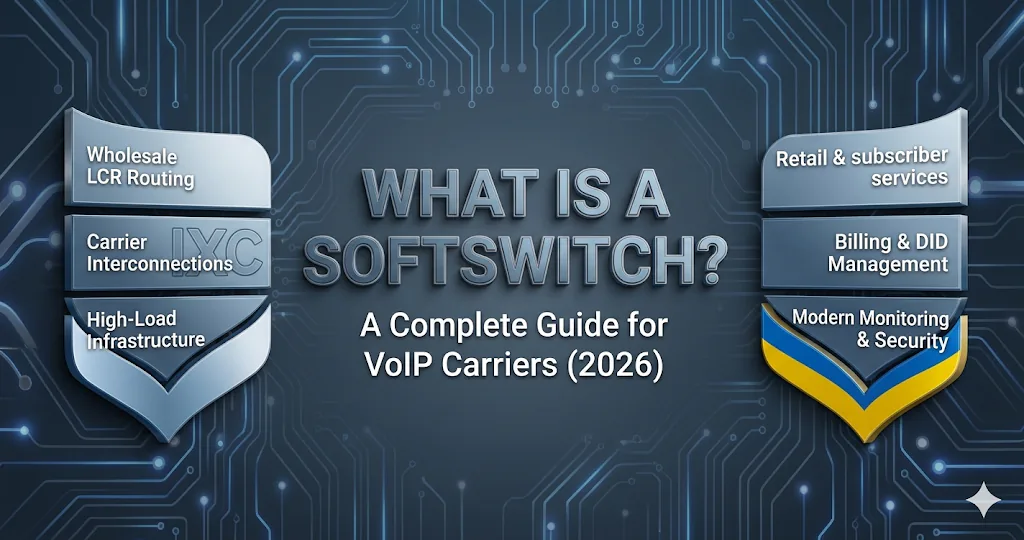
A softswitch is the software at the heart of every modern VoIP network. It decides where each call goes, connects carriers and customers over IP, applies rates, and records every billable second — all in software running on standard servers instead of legacy switching hardware.
This guide explains what a softswitch is, how it works, the difference between Class 4 and Class 5 systems, the features that matter for wholesale and retail VoIP, and how to choose the right platform in 2026.
What is a softswitch?
A softswitch (short for "software switch") is a software-based call-control system that routes voice and SMS traffic across IP networks. It replaces the proprietary, hardware-based telephone switches of the PSTN era with flexible software that runs on commodity Linux servers or in the cloud.
In practice, a softswitch sits between your suppliers (carriers that terminate calls) and your customers (operators, call centers, or end users). It receives a call, looks up the best route, applies your pricing and policies, and bridges the two legs together while metering the call for billing.
How does a softswitch work?
Every call a softswitch handles is split into two planes:
- Signaling — the setup, control, and teardown of a call, usually over SIP (Session Initiation Protocol) or, in older networks, H.323.
- Media — the actual audio, carried as RTP packets, using codecs such as G.711, G.729, or Opus.
A typical call flow looks like this:
- A customer sends a SIP INVITE to the softswitch.
- The softswitch authenticates the customer and checks their balance and permissions.
- It runs routing logic to pick the best supplier — frequently using LCR (Least Cost Routing) to maximize margin.
- It bridges the call, monitors quality in real time, and writes a CDR (Call Detail Record) when the call ends.
- The billing engine rates the CDR and updates prepaid or postpaid balances.
Class 4 vs Class 5 softswitch
Softswitches are commonly described as Class 4 or Class 5, a distinction inherited from the traditional telephone network:
- Class 4 softswitch — built for wholesale carrier-to-carrier traffic. It focuses on high call volumes, transit and termination between operators, LCR, protocol conversion, and fraud control. Capacity and routing intelligence matter most.
- Class 5 softswitch — built for retail end-user services. It adds subscriber features such as IVR, voicemail, call forwarding, DID management, and customer self-service.
Many operators need both. A single platform can run wholesale Class 4 routing and retail Class 5 features together.
Key features of a modern softswitch
When evaluating a softswitch in 2026, look for:
- Intelligent routing & LCR — priority, percentage, and quality-based routing with A-number/B-number rules.
- Real-time billing — prepaid and postpaid, multi-currency, with live balances and automated rate import.
- Monitoring & alerts — ASR, ACD, PDD, and margin metrics with thresholds and instant notifications.
- Security & anti-fraud — SIP firewall, DDoS protection, white/black lists, and FAS detection.
- APIs & integrations — REST/JSON APIs so you can automate provisioning and connect external systems.
- Scalability — thousands of concurrent channels per server and clean horizontal scaling.
Softswitch vs SBC, PBX, and media gateway
These terms are often confused:
- A softswitch routes, controls, and bills calls across a network.
- An SBC (Session Border Controller) secures and normalizes SIP at the network edge; it complements a softswitch but doesn't replace its routing and billing.
- A PBX serves a single organization's internal phones.
- A media gateway converts between IP and legacy TDM/PSTN circuits.
How to choose a softswitch
Use this checklist when comparing platforms:
- Does it support your scale — channels, calls per second, and CDR volume?
- Does it offer the routing and billing depth your business model needs?
- How strong are its security and anti-fraud tools?
- Are there open APIs for automation and integration?
- What does support look like — is there a 24/7 NOC?
- Is it proven in production with real carriers?
Common softswitch challenges
Operators most often struggle with:
- VoIP fraud — stolen credentials and traffic pumping that drain balances.
- FAS (False Answer Supervision) — suppliers billing for calls that never truly connect.
- DDoS and SIP floods — attacks that overload signaling.
- Quality drift — falling ASR/ACD that erodes customer trust.
The right softswitch turns these from emergencies into controlled, monitored events.
Summary
A softswitch is the control and billing core of modern VoIP. Wholesale operators rely on Class 4 transit and LCR; retail providers need Class 5 subscriber features. Combining both on one stack keeps routing, CDRs, and monitoring aligned. When comparing platforms, weigh scale, billing depth, security, APIs, and operational visibility — not headline rate alone.
Frequently asked questions
What is a softswitch in simple terms?
A softswitch is software that connects and routes phone calls over the internet, deciding where each call goes and recording it for billing — doing in software what old telephone exchanges did in hardware.
What is the difference between a Class 4 and Class 5 softswitch?
A Class 4 softswitch routes high-volume wholesale traffic between carriers, while a Class 5 softswitch delivers retail features to end users such as voicemail, IVR, and call forwarding.
Is a softswitch the same as a PBX?
No. A PBX serves one organization’s internal phone system, while a softswitch routes and bills traffic across an entire carrier network.
What protocols does a softswitch use?
Most softswitches use SIP for signaling and RTP for media, with some supporting H.323 for legacy networks and SMPP for SMS.
Can a softswitch run in the cloud?
Yes. Modern softswitches run on Linux servers and public cloud platforms, often with managed databases and elastic scaling.