
Wholesale SMS Platform: SMPP, A2P Routing, Billing & AI Content Control
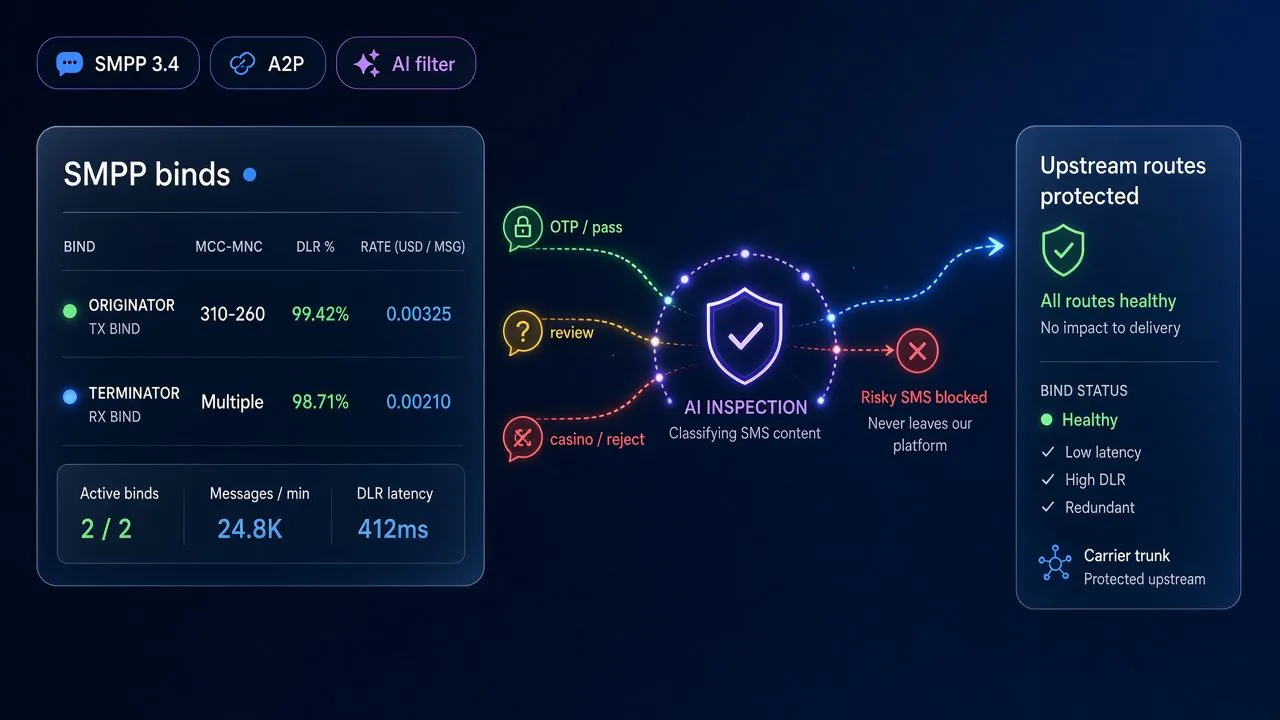
A wholesale SMS platform is how aggregators buy and sell A2P traffic: SMPP binds, routing, and billing. In 2026 that stack is not enough. Carriers drop you when casino, scam, and other blocked content leaks onto a bind they trusted — then your clean OTP customers lose the route too.
IXC SMS Platform is switching plus billing on IXC Softswitch (or as a standalone module). IXC SMS AI sits on the same path: analysis, realtime detect-and-reject, or both, so risky messages die on your switch instead of on the terminator's filter.
What wholesale aggregators actually run
This is not a retail SMS gateway. A wholesale SMS company interconnects:
- Originators — aggregators, enterprises, CPaaS, OTP senders
- Terminators — MNOs, other wholesalers, country routes
- SMPP 3.4 (and often HTTP) as the bind protocol
- Per-message rating, prepaid wallets, postpaid credit
- DLR (delivery reports) as the quality metric — the SMS analogue of ASR
The platform must route, bill, and fail over. It must also prove to upstream that the mix you send is the mix you claimed.
SMPP, A2P routing, and billing
SMPP 3.4
SMPP is how wholesale SMS moves between platforms: bind, submit, DLR, throughput limits. IXC speaks SMPP 3.4, on the softswitch base or as a separate module that can start on one server.
A2P routing
A2P (application-to-person) is OTP, alerts, notifications, and marketing. Routing is not "cheapest prefix":
- Destination MCC-MNC / operator
- Vendor DLR, latency, and throttle
- Sender ID and registered vs unregistered policy
- Failover when a bind or vendor fails
- Separate commercial classes so transactional traffic is not mixed onto a route that forbids promo
Same idea as LCR for voice, with delivery rate instead of ASR.
Billing
Every message is a rated event — the analogue of a voice CDR:
- Prepaid and postpaid originators
- Buy/sell rates by destination
- Credit limits and real-time balance
- Invoices and traffic reports
Without billing you cannot run wholesale. Without content control you cannot keep the routes you opened.
Why routes die: casino, scam, and blocked A2P
Upstream carriers and MNOs filter:
- Casino / gambling promo
- Scam and phishing — fake banks, fake OTPs, "verify your wallet"
- Brand impersonation and noisy or malicious short links
- Adult / high-risk where the interconnect forbids it
- Other packs the destination market treats as blocked content
Typical sequence: complaints and content-filter hits, then your bind or IP is removed from routing. You notice when DLR collapses and the account manager says the route is closed.
Keyword lists lag. Templates rotate. One originator can poison a shared trunk overnight. Wholesale providers need to see the mix and stop the message before it is submitted upstream.
IXC SMS AI — analysis, realtime, or both
Same commercial idea as AI call analysis on voice: know what you carry, then act. SMS is text, so you can go further — reject on the submit path.
Choose the mode per client and per route.
1. Analysis — know your traffic
You mark an originator, a day, a destination, or a sample of stored messages. IXC returns a traffic-profile report:
- Share of casino / gambling
- Scam / phishing / social-engineering cues
- Transactional OTP / alerts vs promo
- Adult / high-risk where relevant
- Other verticals your team names (on-demand detections)
Use the report to reprice, freeze an originator, show a carrier a clean profile, or decide which label packs belong in realtime. This is the commercial layer: know your traffic before you argue about DLR.
2. Realtime — detect and reject before the carrier
On each submit (SMPP or API), AI inspects body, sender, and destination against your policy, then:
- Pass — clean transactional / allowed class
- Reject — the originator gets the error; the terminator never sees the message
- Quarantine — hold for review instead of burning a route
- Policy route — send only to vendors that accept that class (do not dump casino onto a premium OTP bind)
Realtime is what keeps you in the carrier's routing table. Analysis without reject still lets the next burst through.
3. Both — recommended for wholesale
- Analysis tunes thresholds, sender packs, and URL/host fingerprints
- Realtime enforces them on every message
- Rejects and quarantines feed the next report so models follow new casino/scam templates
Run analysis-only while you learn a new originator; switch on realtime once policy is set; keep both on shared high-risk routes.
The goal is not a public blacklist. The goal is that blocked A2P dies on your platform before the upstream moves you out of routing.
On-demand detections
Clients ask IXC to look for the issues that actually get them dropped in their markets, for example:
- Casino / betting / slots promo (local language)
- Phishing and fake-OTP brand packs
- Investment / wallet-drain lures
- Short-link and domain hosts already tied to filtered A2P
- Originators tagged OTP who start sending promo
Tell IXC what to detect; mark a sample; run analysis, realtime, or both.
What stays on the platform
AI does not replace the switch:
- SMS routing, billing, and switching on one stack
- SMPP 3.4
- Scale from low volume to thousands of messages per hour
- Buy or rent, 24/7/365 NOC
- Same company as wholesale voice if you run both
Content control is how that stack stays interconnected.
Summary
A wholesale SMS platform is SMPP, A2P routing, and billing. Aggregators lose carrier routes when casino, scam, and blocked A2P reach the terminator. IXC adds AI analysis, realtime detect-and-reject, or both — so risky messages never leave your switch.
See IXC SMS Platform or talk to sales.
Frequently asked questions
What is a wholesale SMS platform?
Software that interconnects SMS originators and terminators with SMPP (typically 3.4), A2P routing, per-message billing, DLR, and credit control — the SMS equivalent of a Class 4 switch plus billing.
What is the difference between analysis and realtime SMS AI?
Analysis is a batch traffic-profile report on marked messages or originators (casino, scam, OTP vs promo, and on-demand packs). Realtime inspects each submit and can pass, reject, quarantine, or policy-route before the upstream carrier sees the message. IXC offers either mode or both.
Why do carriers remove SMS wholesalers from routing?
Usually content: casino/gambling, phishing, brand impersonation, or other blocked A2P on a bind they trusted. DLR then collapses for every customer on that trunk, not only the offender.
Does reject happen before the terminator?
Yes. In realtime mode the originator receives the error on submit; the terminator never sees the message. That is the point — protect the interconnect, not clean up after a complaint.
Can detections be customized?
Yes. Clients specify on-demand packs for the markets that actually drop them — local-language casino, fake-OTP brands, hosts, or OTP accounts leaking promo — then run analysis, realtime, or both.