
IXC call analysis — mark recorded calls, get the report back automatically
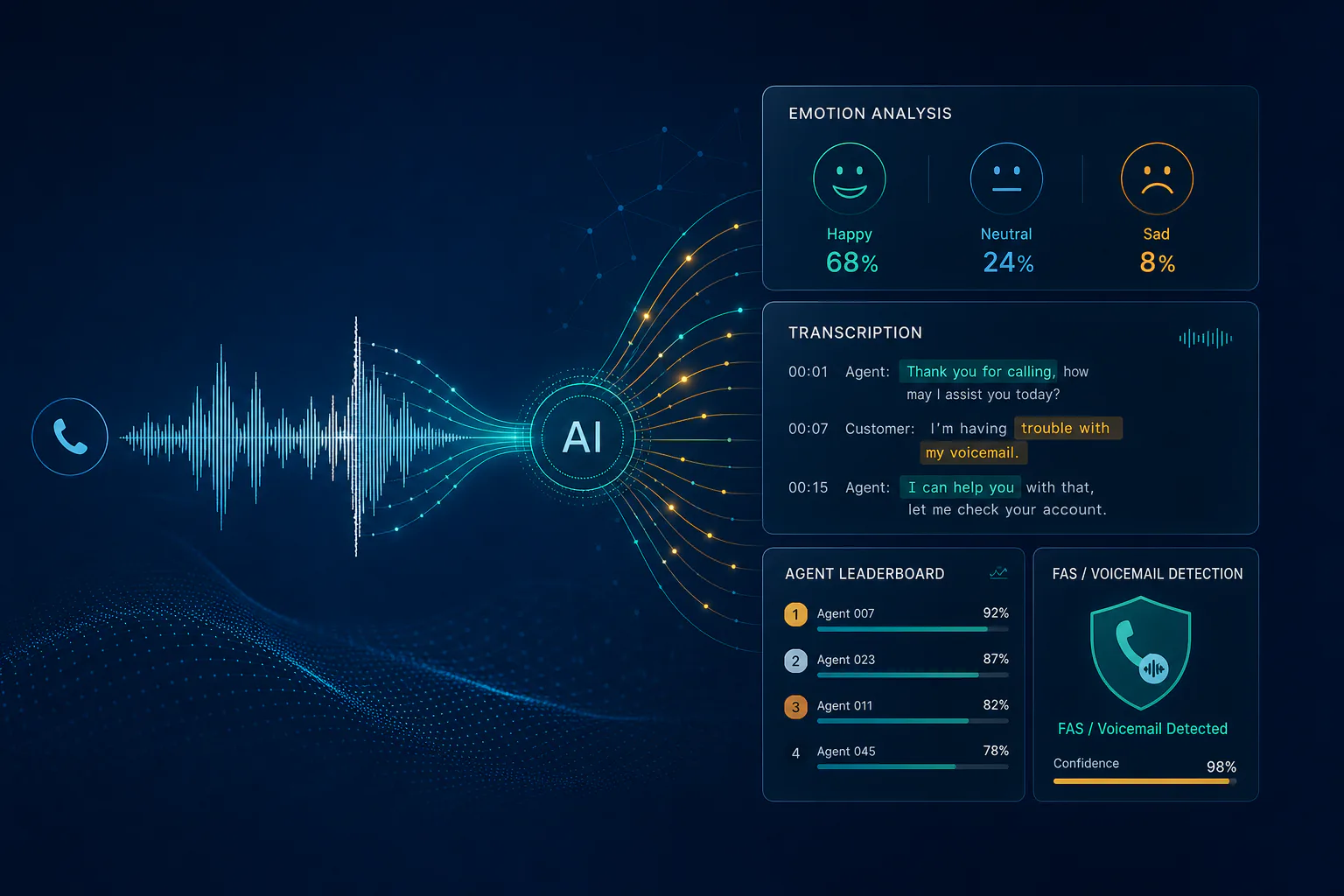
Organised voice recordings on IXC Softswitch and in IXC Billing 7 unlock the next layer IXC delivers to clients: AI call analysis on post-recorded media — traffic-profile reports, coaching insight, voice quality, and FAS/voicemail detection after the call is stored.
This is an IXC service, end to end inside your platform. You mark the calls, send them for analysis, and receive an automatic report back in IXC.
See also the IXC Recording product announcement.
How the client workflow works
1. Record — Softswitch captures audio for the traffic you enable; Billing 7 keeps the archive findable. 2. Mark — Select calls or batches: coaching samples, suspect prefixes, a day’s wholesale dump, or a compliance set. 3. Send from IXC — Submit marked media for analysis without leaving the platform. 4. Get the report in IXC — Results return automatically — ready for commercial, NOC, and quality teams.
Same switch. Same billing UI. Analysis as a managed IXC deliverable on recorded audio.
Why recordings come first
Without a structured archive, analysis never scales: you cannot score conversations, classify traffic, or train FAS/voicemail models if every Call-ID is a hunt on disk.
With IXC Recording, media is browseable by hour, searchable, and reachable from Originator/Terminator reports. That same store is what you mark and send for post-recorded ML review.
High-level traffic report — deep profile insights
Beyond single-call coaching, IXC analysis returns a high-level traffic report built from ML/AI transcription review across the marked batch:
- Traffic profile — what mix are you really carrying?
- Call-centre patterns — agent/customer dialogue, hold, scripted openers
- Scam / social-engineering cues in speech and transcript
- Gambling / casino and other vertical markers
- Adult / high-risk content signals where relevant
- Other verticals your commercial team cares about
Transcription + ML review turns a pile of CDRs into a readable profile of the voice you terminate or originate — know your traffic, and you sell it more competitively.
Voice quality — hear the real line
The report also surfaces real voice quality from the media itself — not only signalling metrics:
- Speech clarity and usable (“cleared”) minutes vs total duration
- Noise, one-way audio, dead air, and clipped speech patterns
- Codec / media issues that explain poor ACD without blaming the route alone
Useful for wholesale quality disputes and for deciding which suppliers deserve traffic.
Sample analysis report — what clients get back
Example insight from an IXC call-analysis run on recorded call-centre traffic:
Volume & coverage
- 1,217 calls analysed
- 2,154.1 total minutes (1,596.5 speech-only / “cleared” minutes)
- 12 unique agent voiceprints
- Dominant language on both legs (example run: Czech)
- Transcriptions for customer and agent sides
Emotion & coaching
Customer emotion mix (share of labeled moods above 10%):
- Happy — 35.2% → mine winning phrases; propagate into scripts
- Neutral — 27.2% → biggest upside: discovery, mirroring, closing cues that convert neutral → happy
- Sad — 22.2% → diagnose root causes (delivery, pricing, hold time) and target coaching
Score = 0.60 × transcript sentiment + 0.40 × customer mood. Satisfied when Score ≥ 0.60.
Team snapshot:
- Top satisfaction rate: agent_13 — 38.9%
- Highest customer speech-only talk: agent_2 — 136.2 min
- Best average score: agent_5 — 0.54
Post-detections in the same report
- FAS / false-answer candidates flagged on stored media
- Voicemail / IVR / non-human answer candidates
- Speech fingerprints of those detections — stored so ML can recognise the same patterns later on new recordings
- Supplier / prefix rollups when FAS or voicemail rates climb in the batch
Immediate playbook: convert even half of neutral to happy → measurable CSAT/NPS uplift without extra headcount — while the same report feeds fraud and quality fingerprint libraries.
Post-recorded FAS & voicemail detection (+ fingerprints)
Wholesale and retail still lose money to:
- FAS (False Answer Supervision) — billed “answered” media that is not a real conversation
- Voicemail / IVR dumps — answered channels that never reach a human
IXC analysis works on post-recorded calls (the media already in Recording):
- Detect FAS and voicemail signatures on the stored audio
- Mark those detections on the call
- Extract a speech fingerprint for each FAS/voicemail pattern
- Reuse fingerprints so later batches (and future detectors) recognise the same audio signatures faster
Evidence stays next to the call in IXC — same habit as PCAP — without claiming live in-call disconnect in this layer.
On-demand detections — what clients ask for
Analysis is not a fixed checklist. Clients request on-demand detections for the issues they actually need, for example:
- Custom traffic-profile labels (branded scam packs, local verticals, competitor scripts)
- Prohibited phrases, risky promises, compliance packs per market
- Language / dialect mix on a destination
- Agent interruption rate, hold-time speech, script drift
- One-way audio or silence thresholds for a specific supplier
- Fingerprint packs for known FAS or voicemail banks in a region
Tell IXC what to look for; mark the sample set; get the report back in the platform.
Call-centre traffic — possible next features
For call-centre flows, transcripts unlock more than coaching scores. One high-value path:
- SMS post-call campaigns — messages generated from the call transcript, 100% personalised, that follow the call (offer, reminder, next step, satisfaction ask — tied to what was actually said)
- Triggered after the conversation ends, not generic blast templates
- Same Recording + analysis stack: mark the traffic, get transcript insight, then act on the outcome
Who benefits
- Call centres — CSAT/NPS coaching from emotion and transcript scores; path to personalised SMS follow-ups after each call
- Traffic-profile / commercial — high-level reports that classify scam, gambling, casino, call-centre, and other verticals from ML transcription review
- Wholesale NOC / quality — post-recorded FAS and voicemail marks, voice-quality insight, supplier rollups
- Compliance — searchable transcripts and audit-friendly evidence
- Routing / fraud teams — growing fingerprint libraries from marked detections for later ML matching
How the pieces fit
- IXC Softswitch — captures and stores media when recording is enabled
- IXC Recording — Billing 7 archive you mark and send from
- IXC call analysis — post-recorded ML reports: traffic profile, coaching, voice quality, FAS/voicemail marks + fingerprints, on-demand detections
Summary
IXC Recording stores the audio. IXC call analysis reviews it after the fact: mark calls, get automatic reports — traffic profile, coaching, real voice quality, and post-recorded FAS/voicemail detections with speech fingerprints for later ML. Custom detections on demand for what each client needs. For call-centre traffic, transcripts also open personalised SMS post-call campaigns that follow the conversation. Start with recording on Billing 7.0.90+, then analyse the same files from inside IXC.
Frequently asked questions
Is FAS and voicemail detection real-time in this service?
No. IXC call analysis runs on post-recorded media from IXC Recording. It detects and marks FAS/voicemail on stored audio and builds speech fingerprints for later ML matching.
What is in a high-level traffic report?
ML/AI transcription review across a marked batch to profile what you carry — call-centre, scam, gambling, casino, adult/high-risk, and other verticals your team needs.
Can clients request custom detections?
Yes. On-demand detections cover client-specific issues: compliance phrases, supplier silence thresholds, regional FAS fingerprint packs, language mix, script drift, and more.
How does this relate to IXC Recording?
Recording captures and organises media. Analysis marks calls from that archive, returns reports to IXC, and stores FAS/voicemail fingerprints for future matching.