
ASR, ACD, and PDD Explained for Wholesale VoIP Operators
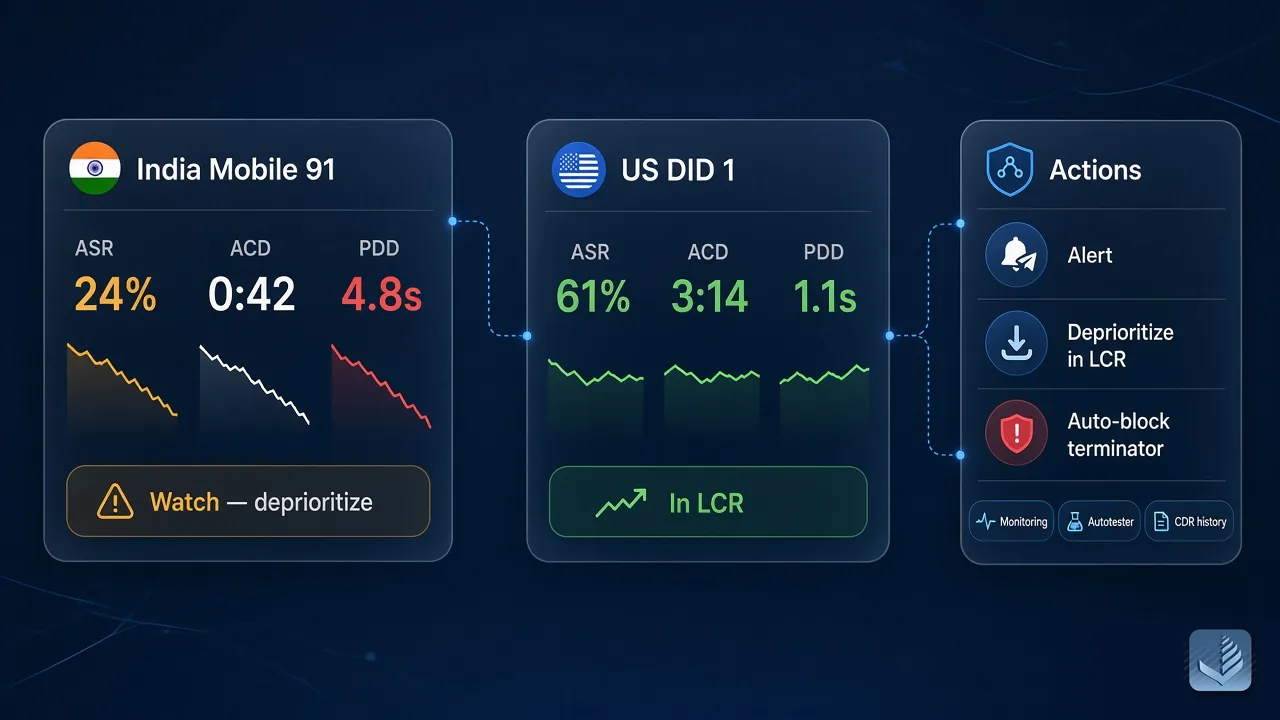
ASR, ACD, and PDD are the three quality numbers a wholesale desk watches all day. LCR ranks vendors by rate; these KPIs decide who is even allowed in that ranking. A correct rate deck and billing do not keep originators if answer rate collapses.
This is not another routing-strategy article. It is what each KPI means on a Class 4 switch, how it moves margin, and which events should alert, deprioritize, or auto-block a terminator.
The three KPIs, in one line
- ASR (Answer-Seizure Ratio) — of the calls you sent, how many were answered
- ACD (Average Call Duration) — how long those answered calls lasted
- PDD (Post-Dial Delay) — how long the caller waited before ring or progress
A fourth report, NER (Network Effectiveness Ratio), treats some non-answers (busy, unallocated) as network-OK. Useful in analytics; wholesale trading still lives on ASR, ACD, and PDD.
ASR — Answer-Seizure Ratio
ASR = answered calls / seizures (attempts). On SIP that is usually a 200 OK with media versus INVITEs that left your switch toward a terminator — or, on the other leg, INVITEs that arrived from an originator.
Wholesale examples, not one global “good”
- US DID / US Fixed — often 40–70%+ depending on CLI quality and whether the mix is conversational or a call center. Sub-20% on a clean US prefix is a red flag.
- India Mobile — 15–35% can be normal for some CLI, time-of-day, and campaign mixes. 50%+ can be too good and worth checking for FAS.
Never compare India Mobile ASR to US DID ASR. Compare a vendor to the same destination, same window, your own baseline.
Originator vs terminator ASR
- Terminator ASR — did this vendor complete the traffic you sent them?
- Originator ASR — is this customer sending an uncallable mix (wrong CLI, robocalls, tests)?
Blocking the wrong side is a common NOC mistake.
How ASR burns margin
You usually bill answered minutes, not attempts. Low ASR still costs you:
- Originators churn when their callers cannot get through
- CPS and channels are consumed by failed hunts
- You look worse than a competitor with the same rate and a better vendor pool
High ASR is not always profit. FAS and voicemail farms inflate answer rate with unusable audio. Pair ASR with ACD and a recording.
ACD — Average Call Duration
ACD = total answered duration / number of answered calls. On IXC, ACD shown to operators is a clock (duration), not a mysterious index.
What short and long ACD mean
- Very short (a few seconds) — FAS, one-way audio, immediate hangup, wrong destination, or test traffic
- Destination-typical — conversational mobile vs IVR / call-center will differ
- Abnormally long — parking, hold music, or a route that never drops; can also be real high-quality traffic
India Mobile ACD is often shorter than US residential DID. Again: baseline per prefix, not a global three-minute rule.
How ACD burns margin
- Short ACD: fewer billable minutes per connect; originators complain about dead air
- FAS: you may pay for fake answers and bill customers who then dispute
- ACD collapse on one vendor while others hold: that vendor, not the destination, is the problem
PDD — Post-Dial Delay
PDD is time from seizure (INVITE out) until the caller hears ringing, early media, or SIP progress. High PDD is callers hanging up in the hunt.
Wholesale hunts make PDD additive: vendor A timeout + vendor B timeout = the originator already dropped.
What high PDD means
- Terminator slow to 18x / 183 / 200
- Too many failover attempts in the hunt
- SIP issues, congestion, or a vendor that parks INVITEs
- Your own CPS limiter or channel cap
How PDD burns margin
Failed-before-answer is often not billed, but you still lose the originator’s next attempt — they send to another wholesale. ASR then falls as a second-order effect of PDD.
Sample size before you act
Five failed calls are not a quality event. Gate alerts on:
- Minimum attempts (or minutes) in the window
- The same destination code, not “the whole vendor”
- Your rolling baseline, not a Wikipedia claim that “good ASR is 60%”
Assign a monitoring profile per originator and per terminator. One global threshold will wreck India while it “protects” US.
Alert, deprioritize, or auto-block
Use three actions, not one panic button:
- Alert (email / Telegram) — first breach, off-hours, or an originator-mix change. A human listens to an Autotester recording.
- Deprioritize — ASR/ACD below floor but traffic still real; drop the vendor in LCR, keep as failover.
- Auto-block — hard floor + enough sample, profit negative on that prefix, or FAS from autotest. Unblock after a passing test, not after a vendor email.
Also alert on loss of traffic (volume to zero). That is often a vendor outage, not a quality dip.
Quality floors do not replace a correct rate deck. They sit on top of it. Sudden ASR anomalies also belong in the fraud playbook.
IXC: monitoring, autotest, CDR history
On IXC Softswitch:
- Monitoring Tool — real-time ASR, ACD, PDD, and profit vs thresholds; alerts on originators and terminators; auto-block; trouble-ticket mail to suppliers; Telegram; event log
- IXC Autotester — scheduled SIP/H.323 test calls, MP3, FAS detect, before a vendor stays in LCR
- Routing history on CDRs — which vendor actually took the call when quality moved
Common mistakes
- One ASR number for all destinations
- Auto-block on a five-minute window with eight calls
- Treating high ASR as “good” without ACD and a recording
- Ignoring PDD until originators leave
- Watching the terminator only, never originator mix
- No autotest before promoting a cheap vendor into LCR
- Alerts nobody can act on (email floods)
Summary
ASR is answers over attempts, ACD is how long those answers last, PDD is how long the caller waited. Wholesale margin follows those three per destination and per vendor, with sample gates, then alert / deprioritize / auto-block. Pair monitoring with autotest recordings — not with a spreadsheet of “good” percentages.
See Monitoring Tool, Autotester, or talk to sales.
Frequently asked questions
What is ASR in VoIP?
Answer-Seizure Ratio — answered calls divided by seizures (attempts). On a wholesale switch you watch terminator ASR per destination and originator ASR for mix quality, not one network-wide number.
What is a good ASR for wholesale VoIP?
There is no global good ASR. US DID is often far higher than India Mobile on the same platform. Compare a vendor to your baseline for that prefix and window, not to another destination.
What is the difference between ACD and PDD?
ACD is average duration of answered calls. PDD is how long the caller waited before ring or progress. Short ACD often means FAS or dead air; high PDD means hangups in the hunt before anyone answers.
Should I auto-block a vendor on low ASR?
Only after a minimum sample, on that destination — not the whole vendor. First breach is usually an alert; real traffic below floor can be deprioritized in LCR; hard floor plus profit loss or FAS from autotest is auto-block.
Do I need autotest if I already monitor ASR and ACD?
Yes. Live KPIs show that quality moved; a scheduled test call with an MP3 tells you whether it is FAS, voicemail, one-way audio, or a real outage before you promote or unblock a vendor.