
October 2026 report — Routing center, Autotester, CDR media quality (WebV7 v7.1.4 → v7.1.47)
PRODUCT UPDATE
October 2026 — IXC Software Distribution Corp.
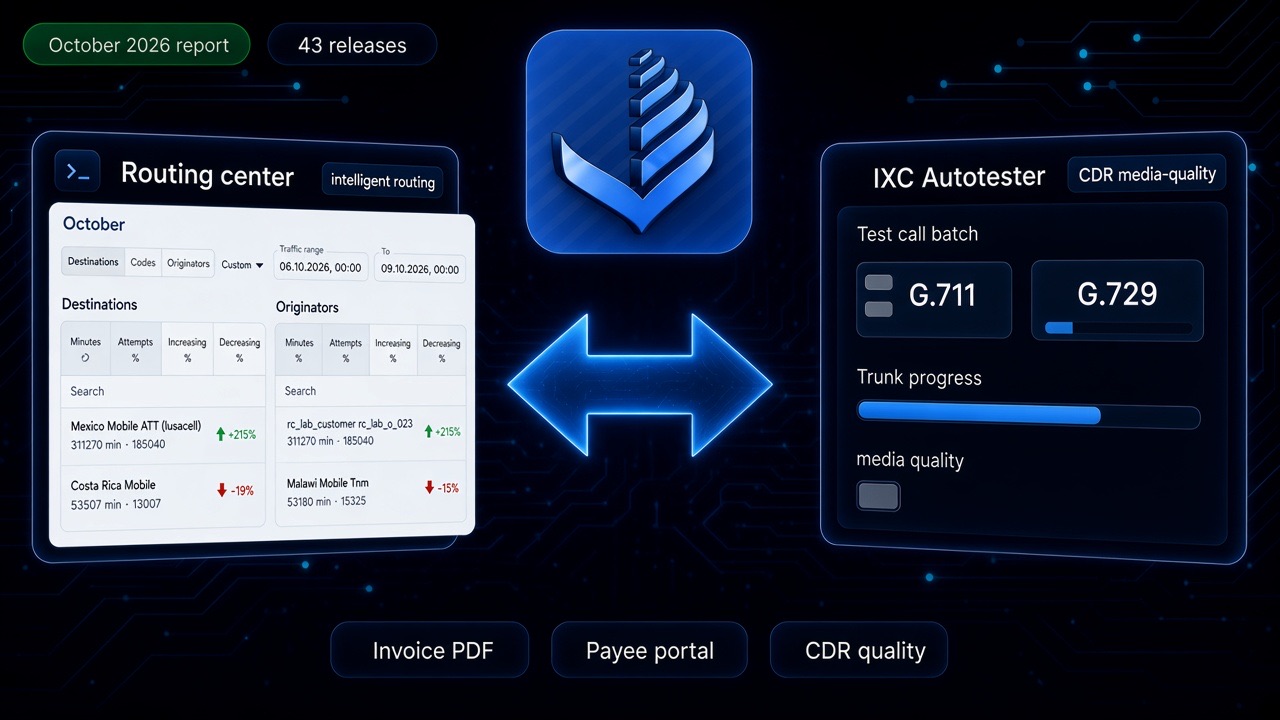
October is a WebV7 month: a Routing center, IXC Autotester, invoices inside the operator UI, and a customer/vendor portal. The switch also writes per-leg media quality onto the CDR, and mixed G.711 A-law / µ-law interconnects translate without a full recode to PCM.
Mr. 6 Foundation published an interview with IXC founder Oleksii Vinogradov — DealoAgent, four people, and their agents.
1. Routing center — one place for traffic and the route
What changed: Routing center is the screen you open to see what the switch is doing, and to change it, without jumping between destinations, routes tables, and call reports.
Pick a window: today, the last hour, 24 hours, 3 days, or a custom from/to. Two lists sit side by side. Start from Destinations, Codes, or Originators. Each row is a name plus the traffic in that window: minutes and attempts. Under the numbers is the change against the previous window of the same length.
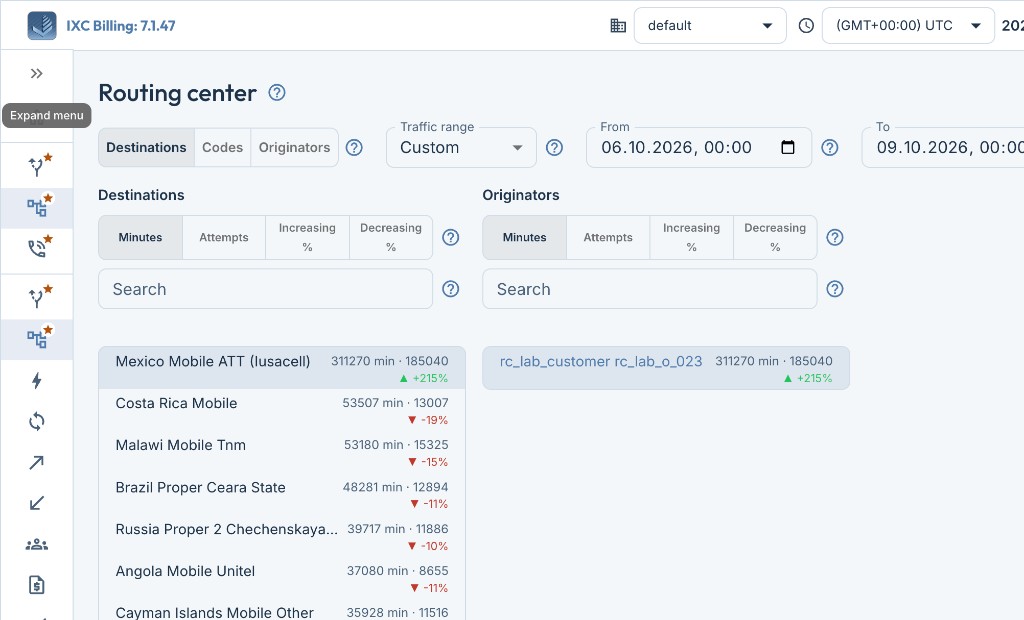
Mexico is up 215% on minutes versus the previous window. Costa Rica, Malawi, and Brazil are down 11–19%. The originator on the right is the trunk that carried Mexico.
Four orders on each list:
- Minutes — busiest first
- Attempts — most tries first. A destination can be loud in attempts and quiet in minutes
- Increasing % — largest rise first. Minutes now and none in the previous window count as the largest rise (the mark reads new)
- Decreasing % — largest fall first
The mark itself:
- ▲ +N% (green) — minutes up more than 1%
- ▼ −N% (red) — minutes down more than 1%
- – — within 1%
- Click the mark and Originator Calls opens for both periods, grouped by hour, already filtered to that destination, code, or trunk
Pick a row and the second list is the other side: originators that sent that destination, or destinations on that originator. Same minutes, attempts, and marks — you see who moved, not only that the country moved.
Under the lists, the route for that pair. A line at the top says what the next call will do. Codes that had traffic in the window are chips on that board, each with its own minutes, attempts, and the same ▲ / ▼. A code marked own vendors has extra suppliers saved only for that code.
On a vendor row: price, the quality numbers the switch already uses, minutes, attempts, and the same up/down mark. Actual is that percent group’s share of minutes in the window, next to the percent you set. Green took traffic and passed the bar. Pale passed and is only backup. Red was removed by the bar. Grey is disabled, excluded, or still inherited.
You change the route on this same page: drag priority, type percents, add a vendor, or replace suppliers for one code or the whole destination. Replace shows a preview and writes nothing until Apply. Reload config sends it to the switch. Calls already up stay up.
Default routes stay the company price list. This screen only turns that fallback on or off for the originator you are looking at. First-time setup from an originator with no table yet creates the routes table and quality rule on the same board.
2. IXC Autotester — a test call through one supplier
What changed: IXC Autotester places a test call through one supplier trunk from WebV7.
- Destination, number, prompt, and codec: G.711 A-law, G.711 µ-law, or G.729
- Several rows run as one batch; the switch reloads once
- Ingress can stay the company default or a chosen customer trunk
- Progress stays on the trunk after you leave the page. Cancel ends a live call
- Optional mail of the result, including the vendor NOC address
3. Media quality on the CDR
What changed: Each call now has full, real voice-quality data on the CDR: packets received vs expected, loss, jitter, and the last RTCP report from the peer (including round trip on a relayed call).
Soon a new routing parameter will use that quality to re-route — drop a bad vendor mid-hunt from the actual media, not only from ASR/ACD/QI.
4. Invoices, portal, and day-to-day ops
What changed: Finance and access catch up with the rest of WebV7.
- Invoice generation from the operator UI, including the logo on the PDF
- Payee portal — a customer sees their originator calls; a vendor sees their terminator calls. Other customers, supplier names, and profit stay off that screen
- Drop an active call from the report
- Rate emails can name the ingress trunk, service class, and customer prefix
- Gatekeeper accounts on a terminator (H.323)
- Mixed G.711 A-law ↔ µ-law interconnects translate directly — faster, same audio
Menus stay English · Русский · 简体中文. Ubuntu 24.04, Ubuntu 26.04, and FreeBSD 14 still ship.
5. Interview with the founder
Mr. 6 Foundation interviewed IXC founder Oleksii Vinogradov on DealoAgent: an AI-native CRM built by four people and their agents, starting in telecom — the industry IXC has served since 1999.
Also this month
- Replace suppliers and percent edits write the originator’s own table (or copy a shared rule for this originator only)
- Active calls stay inside the current company
- In-dialog re-INVITE / hold is more stable
- ACD shown to operators is a clock
By the numbers
| Metric | Value |
|---|---|
| WebV7 releases | 43 (v7.1.4 → v7.1.47) |
| Routing | Routing center for one originator × destination |
| Testing | IXC Autotester — G.711 or G.729 through one trunk |
| CDR | Per-leg media quality (loss, jitter, RTCP) |
Availability
IXC Softswitch and WebV7 updates roll out through your account team: sales@ixc.ua · noc@ixc.ua
About IXC Software Distribution Corp. (™ IXC Softswitch)
IXC delivers carrier-style VoIP infrastructure proven in production since 1999. Office: 7950 NW 53rd Street, Suite 337, Miami, Florida 33166. Media: alex@ixc.ua