
Telecom Industry Concepts: IXC, Softswitch, LCR & Billing
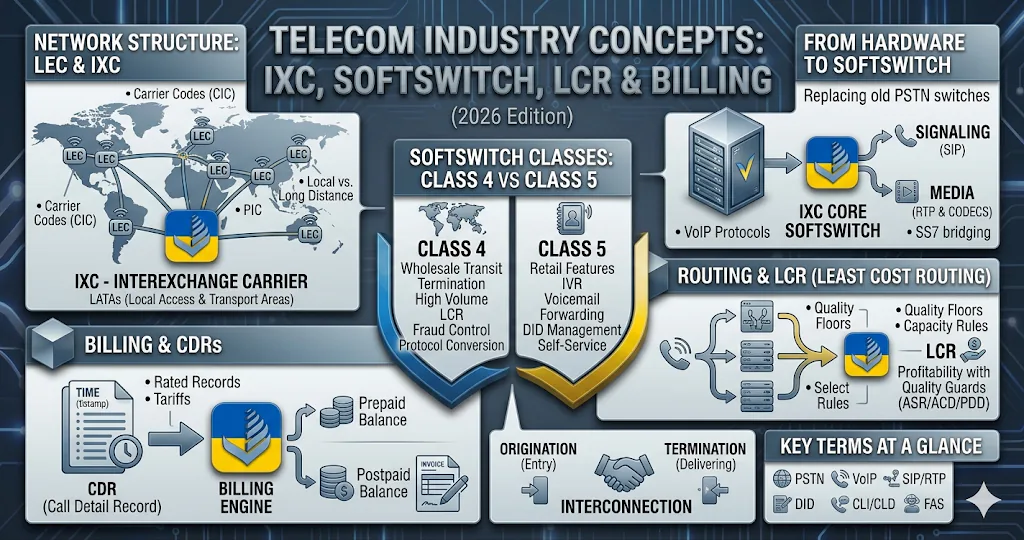
The telecom industry has its own vocabulary — LATAs, interexchange carriers, softswitches, LCR, CDRs. This guide explains the core concepts a modern VoIP operator needs, from the legacy PSTN terms that still shape regulation to the IP technology that runs today's networks.
How the telephone network is structured
Traditional telephony splits the world into local serving areas and the carriers that connect them:
- A local exchange carrier (LEC) handles calls inside a local area — historically a single telephone exchange identified by area code and prefix (NPA-NXX).
- An interexchange carrier (IXC), commonly called a long-distance company, carries traffic between those areas. In U.S. terminology, an IXC moves calls across multiple local access and transport areas (LATAs) — so-called interLATA traffic.
- Each carrier is assigned a four-digit carrier identification code (CIC), and the default long-distance carrier on a line is the presubscribed interexchange carrier (PIC).
These distinctions predate VoIP, but they still drive numbering, interconnection rules, and how calls are rated as local, intraLATA, or interLATA.
From hardware switches to softswitches
The PSTN routed calls through proprietary hardware switches. Modern networks replace them with a softswitch — software that controls call routing on commodity servers.
For voice traffic transfer, carriers now use softswitches and VoIP protocols instead of tandem switches and SS7 alone. Internet telephony service providers (ITSPs) use this to bridge VoIP↔POTS, computer-to-phone, and IP devices to legacy phone services.
A softswitch separates every call into two planes:
- Signaling — call setup and teardown, usually over SIP (or H.323 in older networks).
- Media — the audio itself, carried as RTP using codecs like G.711, G.729, or Opus.
Class 4 vs Class 5
The PSTN's switch hierarchy survives as a naming convention:
- A Class 4 softswitch handles wholesale carrier-to-carrier transit and termination — high volumes, LCR, protocol conversion, and fraud control.
- A Class 5 softswitch delivers retail subscriber features — IVR, voicemail, call forwarding, and DID management.
See our Class 4 vs Class 5 guide for a deeper comparison.
Routing and least cost routing (LCR)
When a call arrives, the softswitch chooses a supplier based on rules: priority, percentage split, quality, or least cost routing (LCR) — picking the cheapest viable route that still meets quality targets. Good routing balances margin against ASR/ACD/PDD quality metrics. More in our LCR routing guide.
Billing and CDRs
Every completed call produces a CDR (Call Detail Record) — the timestamped, rated record used for invoicing. A billing engine rates each CDR against tariffs and updates prepaid or postpaid balances in real time. This is the foundation of VoIP billing on a softswitch.
Interconnection, termination, and origination
- Origination — where a call enters the network (the calling side).
- Termination — delivering the call to its final destination network.
- Interconnection — the commercial and technical agreements that let carriers exchange traffic, settle minutes, and route between networks.
Key terms at a glance
- PSTN — the legacy public switched telephone network.
- VoIP — voice carried over IP rather than circuit-switched lines.
- SIP / RTP — signaling and media protocols of modern voice.
- DID — a direct inward dialing number assigned to a subscriber.
- CLI / CLD — calling and called number identifiers used in routing and fraud rules.
- FAS — false answer supervision, billing for calls that never truly connected.
Summary
Today's VoIP networks still live inside the regulatory and numbering framework of the PSTN — LATAs, interexchange carriers, and carrier codes — while running on software. A softswitch ties these worlds together: it routes calls with LCR, bridges VoIP to legacy networks, and meters every second into CDRs for billing.
Frequently asked questions
What is an interexchange carrier (IXC)?
An interexchange carrier is a long-distance telephone company that carries traffic between local serving areas (LATAs), as opposed to a local exchange carrier that handles calls within one area.
How do softswitches relate to interexchange carriers?
Modern interexchange carriers and ITSPs use softswitches and VoIP protocols instead of legacy tandem switches, letting them bridge VoIP to POTS and route long-distance traffic over IP.
What is the difference between Class 4 and Class 5?
A Class 4 softswitch handles wholesale carrier-to-carrier transit and termination, while a Class 5 softswitch delivers retail subscriber features such as IVR, voicemail, and call forwarding.
What is a CDR in telecom?
A Call Detail Record is the timestamped, rated record of a completed call that a billing engine uses to charge prepaid or postpaid balances.